

Three buckets.
One income.
One annual review.
The Crossing Point Retirement Solution is designed to help advisers manage sequence-of-returns risk by funding regular monthly withdrawals from a dedicated Income Reserve. This reduces the need to sell longer-term investments to meet individual monthly payments, while allowing the remainder of the portfolio to remain invested for long-term growth. Assets equivalent to approximately seven years of planned withdrawals are allocated to the Income and Guardian Reserves, and the rest is invested for the long term at low cost.
13 months of income ready to pay
~7 years of income set aside
25,000 simulated outcomes in the planning tool
No additional Crossing Point charge for the tool
The problem: sequence-of-returns risk
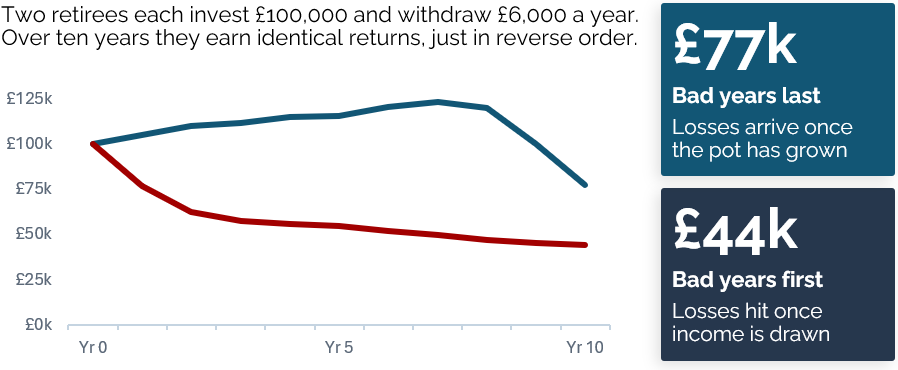
Illustrative, hypothetical example. Annual returns used: -18%, -12%, +2%, +8%, +10%, +6%, +9%, +7%, +11%, +12% for bad years first (and the same in reverse for bad years last). Not a forecast or representative of a Crossing Point portfolio.
Once a client starts drawing an income, the order in which returns arrive matters as much as the average return. A market fall early in retirement, while withdrawals continue, means selling more units at lower prices. That permanently reduces what the portfolio can support.
Sequence risk is one of the main risks in drawdown, and a portfolio built for accumulation does not address it. The Retirement Solution is built for decumulation.
Three buckets
Income Reserve
The Income Reserve is invested in short-dated fixed-income or money market investments, which may fall in value and do not provide guaranteed capital protection. Every monthly payment comes from this bucket only. It holds no equities.
Guardian Reserve
Around six years of income, in Crossing Point Guardian at the client's risk level. Guardian uses trend following designed to protect against drawdowns.
Passive Reserve
The remainder, typically around two-thirds of the portfolio, in Crossing Point Passive at the same risk level. Low-cost index funds, held for the long term.
Once a year, at the annual review, the adviser agrees the income for the coming year and resets the three buckets to these sizes.
This tool gives the trades to place.
Why seven years of income?
Together, the Income and Guardian Reserves hold around seven years of income. Since 1994, the longest time global equities took to regain a previous peak was just under seven years, following the technology crash of 2000 to 2002 (MSCI All Country World Index, total return in sterling). Note that historical recovery periods do not predict future market behaviour, and equity markets may take longer to recover.
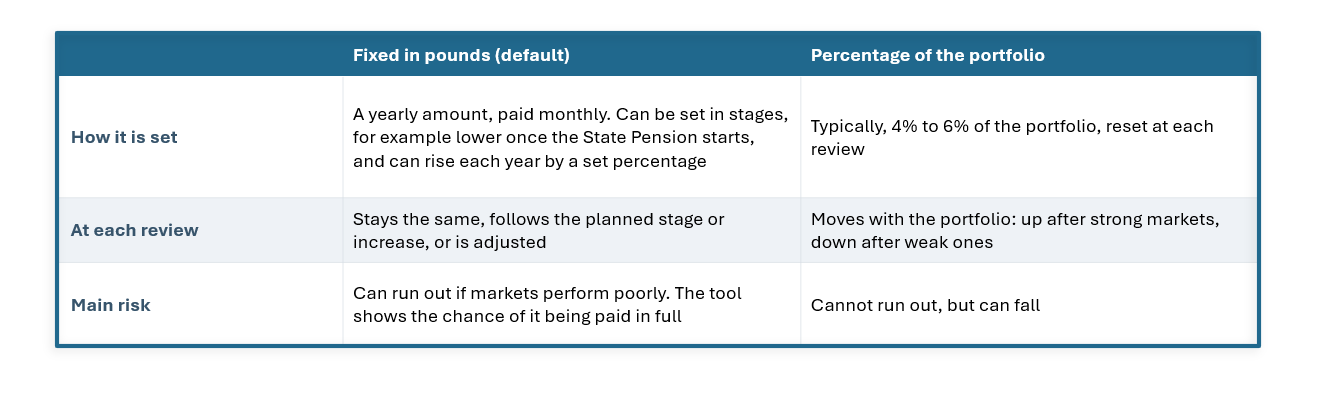
Two ways to set the income
Why it works for clients
1.
Monthly withdrawals are funded from a dedicated reserve
Monthly withdrawals are funded from the Income Reserve rather than directly from the Guardian or Passive Reserves. This reduces the need to sell longer-term investments to meet individual monthly payments. However, annual replenishment may require investments to be sold following market declines.
Lower cost
Guardian's active approach is used only for the next six years of income. For a Balanced client taking 5%, the blended investment cost is about 0.45% a year, against about 0.72% for Guardian alone. Costs are illustrative and exclude adviser and platform charges, which are additional.
A clear process
One rule for sizing the buckets, set by the client's income, not by market views. Easy to explain, easy to review.
2.
3.
4.
Around seven years of income set aside
Enough, historically, to ride out the longest global equity recovery since 1994.
Within the client's risk profile
The Guardian and Passive Reserves are selected to reflect the client’s agreed investment risk profile, while the Income Reserve holds lower-risk investments without direct equity exposure.
5.
Who is our Retirement Solution for?

Clients taking a regular income from a pension in drawdown or an investment portfolio, who want to stay invested.

Clients who value a predictable monthly income and a clear process for where it comes from.

Clients who understand that the income is not guaranteed and have the capacity for loss. It can sit alongside guaranteed income, such as the State Pension or an annuity, that covers essential spending.

Our Retirement Solution is available on the following leading platforms
Questions to ask before you run an illustration
-
Life expectancy rises once someone reaches retirement age. At birth, the average life expectancy in the UK is 79 for men and 83 for women. But according to the Office for National Statistics, a man who has already reached 65 can expect to live to around 84 on average, and a woman to around 86 (ONS, 2025).
-
A moderate retirement costs a single person around £2,700 a month and a couple around £3,800, after tax. A comfortable retirement costs around £3,800 a month for a single person and £5,200 for a couple. Many clients spend more, particularly in the active early years (PLSA Retirement Living Standards, 2026).
Remember to net off the State Pension and any other guaranteed income before setting the income from the portfolio.
-
Care costs tend to arrive late in life, most often in the final two to five years and frequently after 85. A place in a residential care home costs around £67,600 a year on average, and a nursing home around £78,600 (Lottie, 2026).
It is worth discussing early how care would be paid for: from the portfolio, property, family support or a dedicated plan. Because the Retirement Solution is reviewed every year, the income and risk level can be adjusted as needs change.
Figures are UK averages, shown for guidance only, and will vary by location and individual circumstances. Sources:
ONS (2025, accessed Oct 2026): https://www.ons.gov.uk/peoplepopulationandcommunity/birthsdeathsandmarriages/lifeexpectancies/bulletins/nationallifetablesunitedkingdom/2022to2024
PLSA Retirement Living Standards (2026, accessed Oct 2026): https://www.retirementlivingstandards.org.uk/
Lottie (2026, accessed Oct 2026): https://lottie.org/fees-funding/care-home-costs/
For financial advisers only. Not for use with retail clients. The value of investments and the income from them can fall as well as rise, and clients may get back less than they invest. Income is not guaranteed: a fixed income can run out if markets perform poorly, and an income set as a percentage of the portfolio can fall. The Income and Guardian Reserves are initially allocated assets equivalent to approximately seven years of planned withdrawals. These reserves remain invested and do not provide guaranteed income. Their values may fall, and replenishment of the Income Reserve may require investments to be sold following market declines. Fixed withdrawals may exhaust the portfolio if investment returns are insufficient. Percentage-based withdrawals will vary with portfolio value and may fall substantially, potentially becoming insufficient to meet retirement spending needs. The Income Reserve is invested in short-dated fixed-income or money market investments, which are not bank deposits and may fall in value. Guardian’s trend-following methodology is designed to help manage downside risk but cannot prevent investment losses. The Retirement Income Planning Tool uses hypothetical simulations based on historical market data and modelling assumptions. The results are illustrative and do not constitute forecasts, guarantees or reliable probabilities of future investment or retirement outcomes. The solution requires ongoing financial adviser oversight, including regular reviews and timely replenishment of the reserves. Financial advisers remain responsible for assessing client suitability and determining appropriate withdrawal levels. Past performance and simulated past performance are not reliable indicators of future results.