
Fixed income is about income again
At the start of 2026, the outlook for fixed income looked relatively encouraging. After a series of interest-rate cuts by major central banks, inflation appeared to be moving in the right direction, and markets were increasingly focused on when, and how quickly, rates might fall further. But that backdrop changed as the year progressed.
The escalation of conflict in the Middle East pushed oil and gas prices sharply higher, reigniting concerns about inflation and prompting central banks to reconsider the path for interest rates. By the third quarter, more than 80% of developed-market central banks had raised policy rates, while resilient economic growth meant policymakers had less reason to ease [1].
At the same time, pressure has been building at the longer end of the bond market. Governments are borrowing heavily, in part to fund greater spending on defence, infrastructure, domestic manufacturing and technology. Major technology companies are also raising enormous amounts of capital to finance the AI infrastructure build-out. J.P. Morgan estimates that US hyperscalers alone have issued more than $200 billion of long-term bonds during 2026 [2].
Together, that is creating intense competition for capital and helping to keep longer-term yields elevated.
The result has been another difficult period for longer-dated bonds as they underperformed shorter maturities during the third quarter, with 30-year yields in the US, UK and Japan reaching levels not seen for decades.
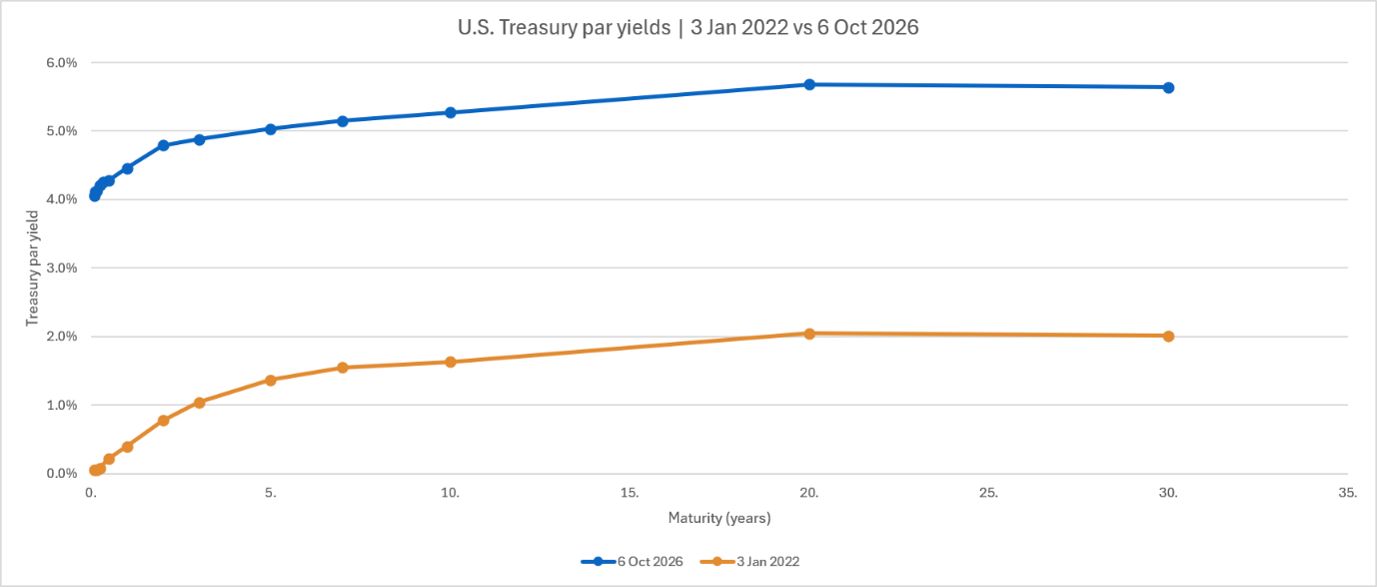
But there is an important difference between today’s bond market and the one investors faced in 2022: yields are now materially higher.
Why this is different from 2022
In 2022, the bond market entered the sell-off from an unusually difficult starting position. Bond yields were exceptionally low after years of very loose monetary policy. When central banks raised rates aggressively, bond prices fell and there was relatively little income to cushion those losses.
Today, the starting point is very different.
Yields across many parts of the fixed income market are now materially higher. Yields in higher-quality fixed income are around their highest levels in roughly 20 years. BlackRock analysis of LSEG data has shown that over 80% of the global bond universe now yields above 4% [3]. This means that investors can once again earn a meaningful return simply from the income their bonds generate.
That changes the role fixed income can play in a portfolio.
Investors do not necessarily need bond prices to rise significantly for fixed income to contribute to returns. Instead, investors can increasingly allow yield to do the heavy lifting.
Why we have remained focused on shorter-dated bonds
At Crossing Point, we have been focused on shorter-dated fixed income rather than taking significant exposure to longer-duration government bonds.
Our trend analysis has continued to indicate caution towards longer-dated bonds, while exposure across shorter-dated bonds, money market strategies, corporate credit, asset-backed securities and actively managed fixed income has allowed portfolios to participate in the higher yields available without taking the same degree of interest-rate risk.
That distinction has mattered.
The shorter end of the market has offered a more attractive balance of income and interest-rate risk while pressure remains on longer-dated government debt. In parts of credit, the current story is increasingly about income rather than capital appreciation.
That is an important distinction. Fixed income is not one homogenous asset class, and opportunities can differ materially by maturity, geography, credit quality and structure.
Why longer-term yields may remain volatile
There are still good reasons to be cautious about assuming that longer-term yields have peaked.
Inflation remains above target in many economies, energy prices remain volatile and central banks may still need to tighten further. At the same time, heavy government borrowing and significant demand for capital from the AI investment cycle are continuing to put upward pressure on yields.
That means longer-dated bonds could remain volatile even if central banks eventually move towards easier policy. A material slowdown in economic growth or a setback to the AI investment cycle could, however, increase the likelihood of central banks cutting rates.
It also helps explain why the relationship between policy rates and long-term bond yields has become less straightforward. Longer yields can remain elevated if investors demand greater compensation for inflation, fiscal risk or the sheer volume of debt being issued.
Is it time to add duration?
Potentially — but we think patience is still warranted.
The compensation investors receive for taking duration risk has become progressively more attractive. Some large global bond managers have therefore begun cautiously extending duration after spending several years concentrated towards shorter maturities, taking advantage of longer-term yields not seen for decades.
There are also circumstances in which longer-duration government bonds could become particularly valuable.
If inflation pressures ease, economic growth weakens or the AI investment cycle suffers a setback, markets could begin pricing lower interest rates. In that environment, longer-duration bonds could potentially benefit from both their starting income and capital appreciation.
Government bonds could also provide important portfolio protection in an AI-related downturn, even though they remain under pressure in the current environment.
But we do not think it makes sense to assume that point has already been reached.
A changing opportunity
The conclusion is not that fixed income has suddenly become straightforward.
Bond markets are likely to remain volatile, and selectivity matters.
What has changed is the starting point.
After many years when yields were exceptionally low, investors can once again earn meaningful income from fixed income without necessarily taking substantial duration risk.
For now, our approach remains selective: earning the available yield, keeping duration controlled and allowing the evidence, including our trend analysis, to guide when it becomes appropriate to take more interest-rate risk.
As yields continue to reset, the question now is “where in the bond market are investors being best rewarded for the risks they take?”
[1] J.P. Morgan Asset Management, “Review of Markets over the third quarter of 2026”, Monthly Market Review, 1 October 2026.
[2] J.P. Morgan Asset Management, “Review of Markets over the third quarter of 2026”, Monthly Market Review, 1 October 2026.
[3] BlackRock Investment Institute, “Income restored – but stay flexible”, Investment Perspectives, August 2026.
